
A Practical Guide to Buying a Freeze Dryer: Temperatures, Capacity & Control

If you are thinking about purchasing a freeze dryer, either for the first time or if you’re upgrading your existing freeze dryer, you may find it helpful to consider the points below.

Why Freeze Dry?
Freeze drying (also known as lyophilization) is a form of dehydration. By freezing the samples and lowering the pressure, the moisture content is removed. The freeze-drying process facilitates preservation of the original shape, colour and properties of the samples.
Freeze Dryers are used for preserving a wide variety of sample types, including pharmaceutical preparations, foods and beverages, biological samples, flowers and archaeological artefacts. The common objective is the long-term preservation of samples without affecting their integrity.
The type and temperature requirements of the sample being freeze dried will impact your choice of freeze dryer, as will your capacity and control requirements - and your budget.
Freeze Dryer Budget
What can you afford? A good quality, UK manufactured benchtop freeze dryer, including chamber and vacuum pump, is likely to have a starting price over £13,000.

For pilot and production scale freeze dryers, prices range from tens to hundreds of thousand pounds, usually determined by the capacity, temperature and automation control requirements.
What capacity Freeze Dryer?
1. What Condenser Capacity do you need? A given condenser capacity refers to the ice capacity of the freeze dryer condenser per batch, before defrosting is required.
This is determined by the volume of moisture in your original samples, which converts to ice during the freeze-drying process. This is more significant if you have very wet samples, which are likely to generate more ice.
For example, the LyoDry Compact benchtop freeze dryer has an ice condenser capacity of 5 kg, before defrost is required. The LHS60 LyoDry Heritage has an ice condenser capacity of 60 kg before defrost is required. If you don’t know how much ice your product will generate, trials will help you to determine this.
2. What Chamber capacity do you need? i.e. How much shelf or tray space do you need for the product you wish to freeze dry per batch. Smaller, R&D freeze dryers, such as the LyoDry Compact, are often modular, so you can choose which chamber/drying accessory you need.
This might be an Acrylic Chamber, for bulk samples, often with a tray accessory, for freeze drying multiple samples. Or a manifold accessory, for attaching flasks. Or a combination of both so that you have different options available, for example the LSDCV 8-port lidded acrylic chamber. See Freeze Dryer Accessories for LyoDry Freeze Dryer accessory options.
Pilot scale and production freeze dryers usually have an integral chamber, with a number of shelves offering a total chamber capacity.

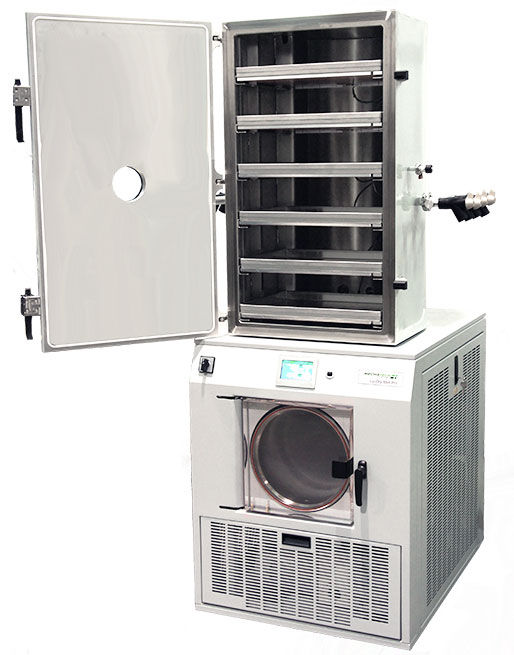
For example, the pilot-scale LyoDry Maxi Freeze Dryer is available with either 3, 4 or 5 shelves, each measuring 360mm W x 480mm D, up to a total of 0.86m2 drying space. Whereas the LSH60 LyoDry Heritage has a chamber housing 5 trays, providing a total of 5.2m² drying space.
Freeze Dryer Temperature
1. What Condenser Temperature do you need? A freeze dryer typically has a condenser temperature of -50°C as a starting point. This is suitable for many sample types, but not all. It depends upon the freezing (eutectic) point of your sample.
For example, if your sample has a freezing point of -20°C, then a -50°C condenser temperature is fine, but if it has a freezing point of -70°C, then you would need a condenser temperature of -85°C.
MechaTech Systems offer freeze dryers with condenser temperatures of either -55°C or -85°C.
2. What Chamber Temperature do you need? Many small lab freeze dryers, such as Benchtop Freeze Dryers and the larger Midi Freeze Dryers, are modular: this means that you can choose the drying chamber – often an acrylic chamber, perhaps with a tray accessory – or a manifold or chamber with ports for flask drying. These types of freeze dryer models do not include pre-freeze, so your samples must be pre-frozen either in an external freezer, or snap frozen in liquid nitrogen.
Heating your product, if appropriate, may accelerate the freeze-drying process. For this purpose, the LSAD6H Heated Chamber and Tray Accessory from MechaTech Systems has a temperature controller and heater mats.
Larger, pilot and production scale freeze dryers, such as the LyoDry Maxi, LyoDry Heritage or the LyoDry Grande include temperature-controlled chambers or shelves. You can both pre-freeze and heat the product.
MechaTech’s chamber freeze dryers are typically available with chamber temperatures controllable between -40°C to 60°C or -60°C to 60°C.
Freeze Dryer Control
What level of control automation do you need? Entry level, laboratory freeze dryers will usually have a basic digital controller and display, showing temperature, vacuum level and readiness. The operator needs to follow certain steps, such as pressing the ‘Pump On’ button to switch on the vacuum pump, when the freeze dryer display indicates that it has reached the correct pre-cooled temperature.
For more closely controlled laboratory freeze drying on a small scale, the LyoDry Benchtop Pro and LyoDry Midi Pro offer touch screen control, data logging, trends, pressure control, USB and ethernet comms.
Pilot and production freeze dryers, such as the LyoDry Heritage, Maxi and Grande, have more comprehensive controllers, usually a touch screen PLC, with pre-programmable, freeze drying ‘recipes’ and endpoint determination.
These provide product protection and require only minimal operator intervention. They often include process and product temperatures variables, and real-time systems status and fault indicators. They also have comprehensive alarm management systems, and the option of remote view via an external computer.
If you’re freeze drying in vials, some pilot and production freeze dryers, such as the LyoDry Maxi and Grande, also offer automatic stoppering of vials.
Freeze Drying Trials
Have you carried out freeze drying trials of your samples? Trials will help you to determine how your specific sample reacts to the freeze-drying process. For example, how long it takes to freeze dry a batch, how much ice your product generates and, importantly, how much it costs in terms of capital outlay and running costs.
Trials can be accomplished either by using a company that offers contract freeze-drying, or by hiring freeze drying equipment and carrying out your own trials. MechaTech Systems offer benchtop freeze dryers for monthly rental.
Freeze Drying Solvents
What solvents are involved in the process? Often, the only solvent present in the freeze-drying process is water. In which case, any freeze dryer chamber is suitable. However, some organic solvents can cause an acrylic chamber to corrode, especially if a high concentration of corrosive solvent is present. In this instance, a stainless-steel chamber is a better option. You may also need to protect the vacuum pump with a chemical trap and sorbent.
Freeze Dryer Installation Considerations
Last, but not least, where will your freeze dryer be installed? A benchtop freeze dryer can sit on a lab bench, or a purpose-built trolley on castors so that it can be moved around the lab.
MechaTech Systems also manufacture the LyoDry Midi modular freeze dryer, which offers a larger condenser capacity (18Kg) than the benchtop freeze dryer (5Kg), and is designed be positioned next to a typical laboratory bench.
The LyoDry Maxi has a built-in chamber on top, so needs height, but is designed to fit through a standard laboratory doorway.

The LyoDry Production Freeze Dryer, however, is a through-the-wall design – so only the chamber doorway and operator control are accessible in the clean room, whilst the mechanical parts such as the vacuum pump and condenser are located in a separate plant room.
Summary: Key Points to Consider when Buying a Freeze Dryer
What is your budget?
What condenser and chamber temperatures do you need?
What condenser chamber capacity do you need?
Are there any solvents present? At what concentration?
What level of automation control do you need?
Have you conducted freeze-drying trials?
How much space is available for installation?
Need Help Buying a Freeze Dryer?
MechaTech Systems manufacture LyoDry Freeze Dryers, at our Bristol, UK facility. We can provide advice, quotations and practical support - including rental freeze dryers for trial freeze-drying.
For further information, please contact us: enquiries@mechatechsystems.co.uk / +44 (0) 1454 414723 or visit https://www.mechatechsystems.co.uk/freeze-dryers.

Comments